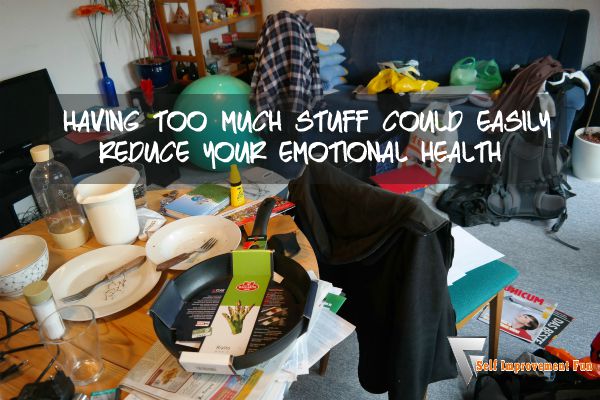
Having Too Much Stuff Could Easily Reduce Your Emotional Health
Your emotional health could be lingering solely due to having too much stuff in your life. For a moment, think about the state of your house and the possibility of how that could be affecting how you feel. Are you currently feeling stressed, slightly overworked, and somewhat tired each day An obvious possibility is clutter, which is basically brought on by excessively holding on to added things and miscellaneous stuff. This alone can easily cause large amounts of stress. It can also make you sluggish by draining you of energy, which ultimately makes it difficult to get a good amount of rest.
By simply tackling the problem related to clutter in both your home and office area, you’ll be able to improve emotional health, overall productivity, focus and attention, and best of all, sleeping patterns. In this article, let’s try to examine clutter, what it can do to you, and how reducing it can improve your emotional health and well-being.
What’s clutter got to do with it
In order to eliminate or remove clutter, we need to discover what it is. Being a subjective term, clutter is basically used to describe the unnecessary, excess items which take up space. There are various types of clutter which exist according to some organizational experts presented by WebMD. Doheny (2008) explains how organization expert Peter Walsh separates clutter into two categories.
The first, memory clutter
Memory clutter is just what it sounds like. It’s clutter which basically reminds us of certain and important events surrounding our lives. This could be something simple as a note, a card, a movie ticket, miscellaneous clippings, etc. Most of these will typically have some close meaning or level of sentimental attachment, which makes them harder to part with (Doheny, 2008).
The second is referred to as someday clutter
Someday clutter refers to those items that people hold on to, simply because they believe the items will be used someday in the future. These items could range from extra utensils, lamps, alarm clocks, etc.
The number one thing that these two types of clutter might seem to have in common is basically a lack of use. What normally separates most clutter from other things you have is a lack of use or even a purpose in your life. Clearly, nobody can really identify your clutter, which ultimately makes it subjective. Clutter is something that’s in your possession which you are not using and simply takes up space. It is all about the balance. If you hold on to so much stuff in your life, it merely drags you into the past or simply pushes you into the future, you just can’t live in the present (Doheny, 2008).
Why it’s important to minimize clutter
Clutter can cause us to feel stressed, drained, and anxious. It can make it hard to get work done, to sleep, and to stay focused. Clutter can also contribute to your feeling overwhelmed. It’s bad for your physical, mental, and emotional health; clutter collects dust, mold, and other allergens and takes up space in your home, becoming a fire hazard.
Clutter can cause a stifling feeling in those living in it. Minimizing your clutter can help to ease your stress, increase your productivity, improve your sleep, and simplify your everyday life.
How to minimize clutter
It’s never easy to let go of something you’ve been holding onto, but sometimes it’s necessary. We’ll help guide you through the process in this section.
Analyze the item in question
Why are you keeping it? What purpose does the item serve in your life? Have you thought about it or noticed it in the last month or year?
How much space does it take up
If the item in question is something small and easily storable (like a ticket stub or postcards) with a lot of sentimental value, you should keep the item and store it away. You’ll be glad to have the reminders later in life. However, if the item has little to no sentimental value, you should part with them. Larger items require more thought as you have to factor in if you have the space for it.
Can you bare to get rid of it
If you’re not sentimentally attached to the item and you haven’t used it, you should consider if it’s something with which you’re willing to part. If the goal is to declutter your space, the answer should probably be yes.
Once you’ve gone through and removed the excess clutter, you need to figure out what to do to organize what you have left. Purchasing storage containers, shelves, or putting important or memorable papers in file folders or scrapbooks can help your living space remain clutter-free despite hanging onto some of the “memory” clutter.
References
Doheny, K. (2008). Clutter Control is too much ‘stuff’ draining you WebMD. Retrieved from https://www.webmd.com/balance/features/clutter-control#1


Post Comment